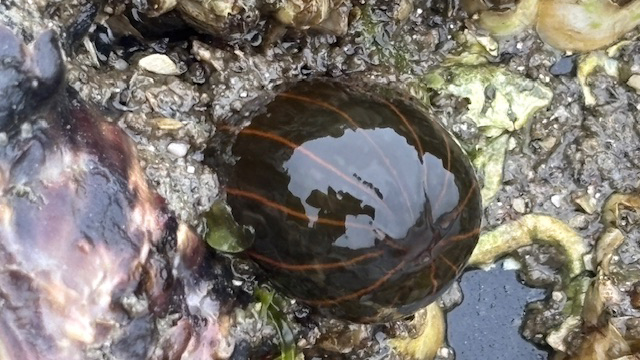
I balance precariously on the drainage pipe, jutting out into the sand flat encrusted with oysters, barnacles, and slippery sea lettuce. My daypack, stuffed with sampling gear and my water bottle, slides into the back of my neck as I stoop to identify the various sea creatures adhering to the thick pipe’s walls. I spy a small green anemone with orange stripes. It has sucked its tentacles into its body and looks like a shiny painted nipple. I remember this anemone from my graduate school days in Elkhorn Slough, California. It is one of the many invasive animals marooned in and negatively impacting that estuary. But here, in Itsukushima Island, Japan, Diadumene lineate is native and at home. It nestles next to encrusting Japanese oysters on hard surfaces in the intertidal sand flats skirting the island’s edge.
I don’t keep life lists of anything, not even a bucket list of places I want to visit. I’m content to follow my whims and the availability of cheap plane tickets because something interesting is everywhere. But when I see a species, I only know as invasive in its natural habitat, a thrill electrifies me, making me giddy. It is like finding an amazing hole-in-the-wall restaurant in a strip mall. Road-weary and hungry, you see a line of beaten-up trucks parked in front of a food joint and decide to try it. The restaurant is known only to the locals, serving up home-cooked delicacies inspired by place, culture, and four generations of recipes. You are eating the buttered steak in Austin, the fresh Dungeness crab from a shack in Newport, Oregon, or sushi in the fishing village of Nachikatsuura, Japan. It is some of the best food you have ever eaten, and you relish the moment– the discovery. This is the feeling I have when I recognize the orange-striped anemone and know that it is in its home, feasting as it should on its authentic diet, snuggled between its evolutionary neighbors. The elation of experiencing a sliver of the unexpected, where it should be expected.
I snap a picture with my phone and continue looking for other species.
Seventeen college students will swarm these sandflats and explore their exposed biological richness in an hour, so I am scouting the area in preparation for my lesson. I want the students to look and observe, to open their minds and eyes to animals, plants, and algae they’ve never seen before, and to be awed. That awe is one of the best ways I know to encourage questioning and observation, to break out of our expectations for the world and see how much bigger and grander it actually is, to roll in curiosity and a need to discover more. This is my lesson’s goal, the reason for coming to this sandflat at low tide, on this island, in this country. It is also the reason for writing this essay. The lesson is designed to expand minds and encourage questions, all by spending the time and making the effort to watch worms, crabs, and snails meander about their daily lives.
To succeed in this learning outcome, I plan to dig in the sand and show my students worms, fingernail-sized clams, and isopods that look like flattened shrimps no bigger than rice grains. I plan to point out holes where larger clams live, squirting water in response to vibrations of our steps that rock their clammy worlds. I plan to show my students snails leaving meandering trails as they munch on the rust-colored film of microscopic algae coating the sand’s surface. As a group, we will hunt for flatworms the size of a quarter or a ¥100 coin. We will watch those flatworms’ bodies flow like slime over our hands until we flip them over and they writhe, undulating waves ribboning along their edges. We will flip them right side up, and the flatworms will slide forward to our chorus of exclamations and questions. This is the world-opening experience I want my students to have, I want my readers to have. To realize that even though so much of our world, form social media to politics, wants to pull us apart our world want to pull us together in the larger community of life.
As an island nation, one would think that Japan would have a more welcoming coastline, but most of Japan is walled off from the ocean or terraformed into harbors and piers. Its food economy depends on fishing. Indeed, its hunger for seafood has impacted global fish populations, contributing to the decline of most of the world’s big fish. Japanese culture looks to the mountains for their grandeur, partly because the sea can be an enemy. This culture evolved in a space filled with natural disasters. Earthquakes spawn tsunamis. Typhoons lead to floods and mudslides. The walls between villages and the sea are there for protection.
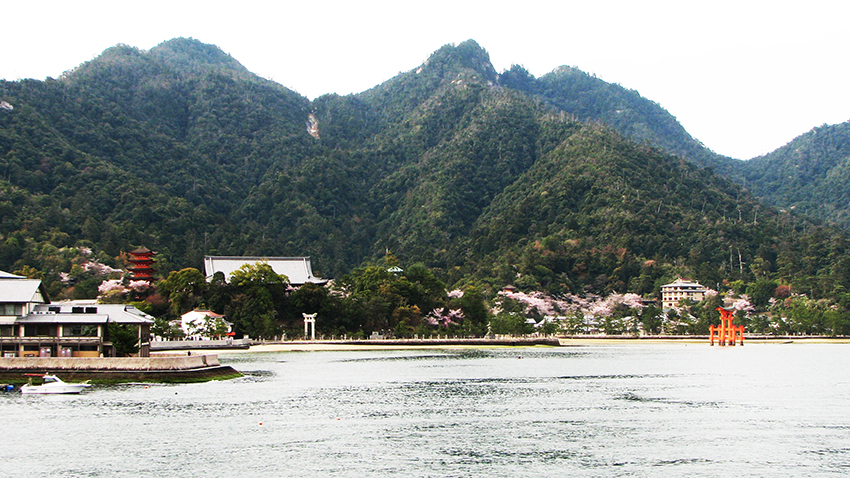
In so many places in Japan, the sea feels like an adversary, or a utilitarian resource, or both. But not in Itsukushima. Here, you are invited down to the sea by stone staircases and the allure of the giant O-Torii. Internationally known, the floating O-Torii gate stands tall as hundreds of people mill around its exposed tree trunk supports. The gate’s bright vermilion paint stands out against the tan sand dotted with green algae, the island’s jade forest, and Hiroshima Bay’s gray-blue waters. This island, a paint tray of vivid color, is considered a Shinto Kami, or god, and the floating O-Torii marks the entrance to the island’s Shinto shrine, Itsukushima-jinja, a series of vermilion buildings connected by walkways that reach out over the sandflat, making the shrine also look like it is floating at high tide. Further inland, climbing up the hillside is Daiganji Temple, and at the island’s peak Daishō-in Temple. The class would explore those later. In this moment, we fixate on the unifying awe-inspiring biology. We accept the invitation to explore this island’s living wonder in the shadow of its history.
Take a picture. Touch the gateway. Pick up a snail.
So often in my work as a biology professor, I deal with stressed-out students eyeing the path toward medical school as an obstacle course of chemical equations and cellular processes that they must memorize and regurgitate back on an exam. They fight me over points and wording of test questions, holding up my PowerPoint slides as evidence of my errors. I point out their misunderstandings and re-explain my lectures as they frown. It is an antagonistic relationship, not unlike Japan has with much of its oceans.
I have much more fun teaching, and my students have more fun learning, when I have the opportunity to engage my students in the world, via field trips, community projects with real- world implications, case study examples with unknowns the students puzzle over, or trips to foreign countries where the students and I both learn together. What is endangered when we teach to the test is the brilliance of applied and tangible learning, where both the body and the mind are a part of the process. Where being “wrong” isn’t seen as a point deduction but an opportunity to look closer, to take a new approach, to be so giddy with lack of understanding that our minds spill over with questions. Being “wrong” should be an exhilarating invitation to learn. We see more if we are excited and guided, learn more if we are having fun and are presented with a novel challenge, and work harder if we know the information we find applies to a real problem. Itsukushima and its sandflats offer the opportunity for that increasingly endangered engaging, novel applied learning.
As the tide recedes further, my students gather around me for their intertidal survey. I see wonder in their eyes— a wonder that seems increasingly hard to find, in a world where we are engulfed in social media and AI is the shortcut around understanding. Where rising populist and authoritarian forces attack science and education, and questioning is becoming a lost skill.
I escorted my students past the O-Torii and tell them to find a pool of water, kneel over it, and watch. The world comes alive when you watch, as if the island’s Kami is animating the sand. Gasps and shouts exploded around me.
“What is this?”
“There are snails everywhere!”
“No way, is that a crab?”
“Dr. Heiman, do you see this!”
“Dr. Heiman, why are there so many snails?”
“Holy shit, this is so cool!”
“Wow, is this a flatworm?”
I don’t care what else they learn. They are amazed and want to know more. This is the goal. This is the gift I wish for us all to receive from this world. The eye-opening wonder of seeing a snail leave a trail in scum, holding a flipping flatworm in your hand, or recognizing a familiar anemone in its home. The wonder that makes you want to look closer, that fills your heart and mind with questions, and makes you want to take the time to discover.
Accept the world’s blessed invitation.
Stop. Watch your step. Crouch down to get closer to the sand, observe, and wait.
The Earth will astound you.
Kimberly W. Heiman is a Senior Lecturer of Biology at Muhlenberg College in Allentown, Pennsylvania. She pursued her passion for spineless sea creatures by earning a BA in Biology from New College of Florida and a Ph.D. from Stanford University. Her pandemic response coping strategy was to take up writing. She is enrolled in the Wilkes University Maslow Family Graduate Program in Creative Writing and is querying her first non-fiction book. Her work has been published in Flash Fiction Magazine and the International Human Rights Arts Movement Literary Magazine, CrayfishMag, and nominated for the Best American Short Stories Anthology.