
FORGET-ME-NOT – Memory always sees the loved ones in miniature.
– Walter Benjamin, One-Street And Other Writings
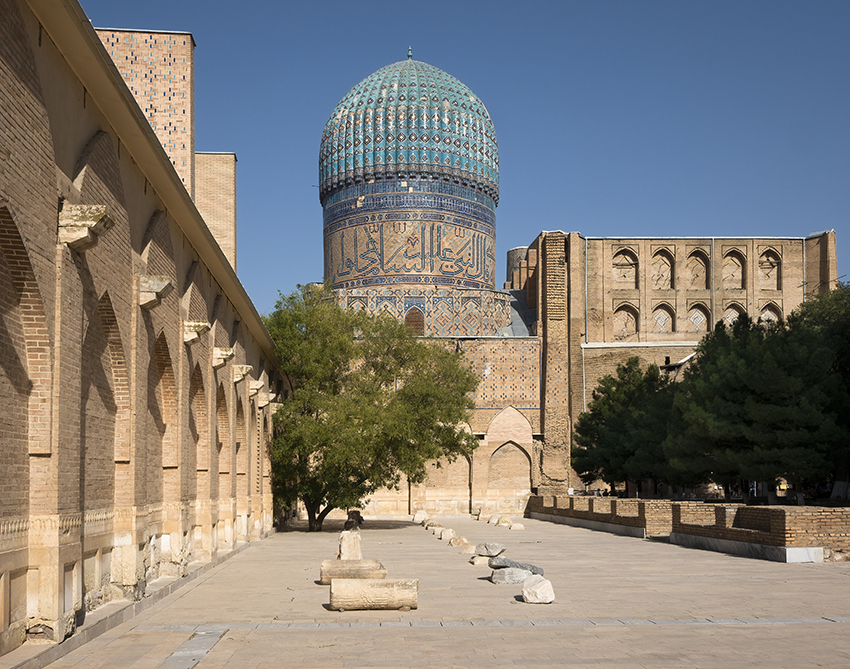
I struggle up an unwavering hour where the blue tile travels. Ko’k g’ish they call it. In Shah-i-Zinda, the city of the necropolis. It goes from lively chants to a chorus, the lissom of turquoise where afternoons kiss the whole body through filigreed blossoms while out walking on a luminous October. In the quiet of slender lanes where even the dust remains still; save for the call to prayer where the calm shatters as loud as love inflects under a nacreous heaven of stars mapping the astronomer’s horizon. Can the sublime ever be sensible? I tenderly graze my hand of calligraphies over the cool lacquered ornamental bricks in a repeated flow as if to spring the fluency of a well gone century. Tap once, twice. A deaf mute. Always diaphanous. Somehow distinct.
Changeless, the ubiquitous master of towering glories, the pischtak arches with its stinging punctual geometries and honeycombed stalactites in concrete echoes. Wall upon wall upon wall graced with God’s blue burning the gem-cut snow of clouds. My eyes scintillate hungry with each slow squint. To see it all without a word uttered is to marvel in the most purest silence. I lose my breath, forgetting of motion, my poise collapsing in its reigning modesty as I linger there enamored of such seraphic divinities.
*
The day after I eat horse meat for the first time I dream of a Mongol empress entering the mulberry courtyard in the shape of a ruby-filled pomegranate. Her silhouette sketched out an Egyptian sage who warns her how only sinners feast upon the meat of a humble horse. If all men are misunderstood, what good is it to declare this without conviction?
Go where the food is pleasant, you’ll find the right people.
I imagine her sensing the unusual: a group of musicians strumming the dutar with strings that smell of catgut. The light trapped in their tongues deepens into metamorphosis. Every rhythm exalts the architect and his kiss crystal as a conscious in reach of a forbidden torment. Yet in time, her veil stains a death so inexorable as a final decree. God save you. There will be no comforter on earth. Here, life and death blur together. Bibixonim, this is the way they will remember you when almost found and forgotten. By the lamp of the evanescent song, the tambourine doves have no good news but will soon gather your soul in wet silk mirrored on the dew of sorrowful fountains.
*
It’s never too late. The autumn sun spirals into rich cinnamon raying the twin minarets in front of us. I finally tell you of a high school friend who entered eternity. He was only thirty-six. Rule number one: Never move places to mourn, you say. Rule number two: Celebrate him instead. Like a torrent of clarity it made sense. Grief to gratitude. You can never learn a lesson without going through the conditions that push for it. How many times have you cried since? I lost count. Erase away those tears now. I’ve got tired eyes that nest in a hollow face, with hair hiding inside my scarf that can engulf it all with a simple tilt of the head. I lost my mother to dementia, not too long ago, you pause, smile and hand me a fresh slice of honey melon. Rule number three: We cry out at the first lash. But with time the tenth becomes bearable.
Rushda Rafeek is a poet and writer whose work was shortlisted for the Wasafiri New Writing Prize (UK) in 2017, nominated for the Pushcart Prize (USA) twice, the winner of Nazim Hikmet Poetry Prize, 2018 (USA), and was selected for the Best Asian Poetry Anthology 2021 (Singapore) and selected for the We Call to the Eye & the Night anthology (Persea Books, 2023). In 2021, her chapbook manuscript was a finalist for the Glass Poetry Chapbook Series, (USA). She attended the Brooklyn Poets Fellowship – Summer 2025 (USA) and was placed finalist for The Kenyon Review Developmental Editing Fellowship for Emerging Writers, 2025 (USA).