
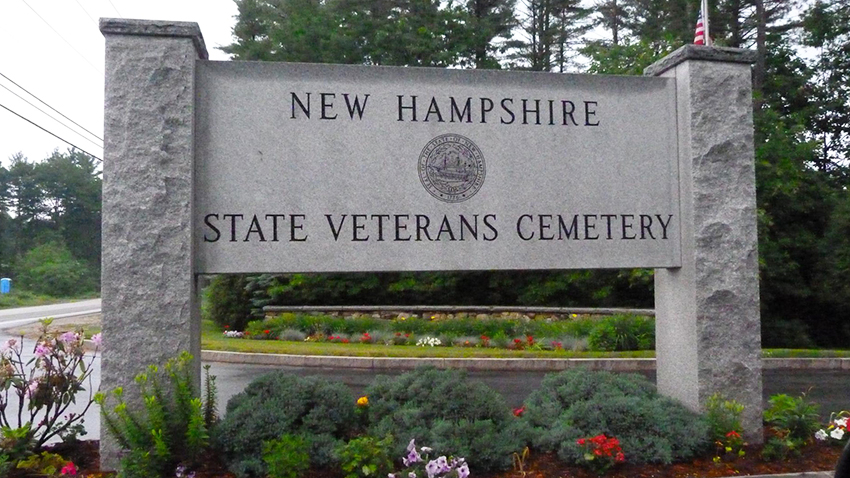
On September 20th I drove with my mom, grandmother and grandfather 40 minutes away to the New Hampshire Veterans Cemetery. It was mostly a silent ride. My grandfather seemed strangely content and was holding up better than either my mom or I had expected.
We pulled through the gates and were directed to the parking lot. My grandfather pulled me aside and opened the trunk. Beside an umbrella and jumper cables sat an open green-marbled stone box, inside of which was a speckled gray plastic bag. “These are your uncle’s ashes. Carry them to the office,” he said gruffly. He said it the same way my father would ask me to bring in the groceries. “Don’t drop them.”
The box was heavier than I imagined ash to be. Its shape, just large enough to be cumbersome as I swaddled its corners into my chest. I watched my feet, worried I would trip, the box spill open and my Uncle would be lost to the wind. My eyes fixed between its lid and the asphalt.
This was Geoff. Or this was what was left of him. It quite obviously was not the person that I had once known. But it was closer to his shape than to the white stones of the veterans around me. Carrying ashes in the box, I tried to guess at my Uncle’s weight. Was this as heavy as he was? How much of his body had been turned to smoke in the air? Its shape was so alien I could not imagine inside of here was my Uncle.
In a literal sense, inside of the box was not my Uncle. Or more accurately, it was not just my Uncle. At the wake my grandmother joked that they had cremated the family dog Ruger who had died a month before and slipped the two bags of ash together. Dogs were expressly “prohibited” in a cemetery for veterans. Then again, how could I tell the two apart when their bodies had become comingled in the urn? What sort of secrets did Geoff bring with him to the grave? All that I know is that at least one of his practical jokes has followed my Uncle unnoticed by the guards into the cemetery.
I have returned to the plot and marveled at Geoff’s headstone. From the surface, it is impossible to know that this grave holds the ashes of two beings. And perhaps, without Ruger’s name inscribed into the white marble, he has been lost entirely. But there still remains the ash. There still remains proof. The secret is surely there.
As I walk the cemetery, I wonder how many are buried here. There are the ones who are given great obelisks and epitaphs in death. There are others whose deaths are silent. Still more, who fade into the earth, their presence known only to the soil.
Adrian Oteiza is an emerging poet primarily based in Providence, Rhode Island. Through the written word, his poems step close to examine the texture and touch of my surroundings and step back to wayfind through geographic space. His current manuscript, Go There, explores two cemeteries in Providence as places that both reflect and refuse death. Adrian’s written work can be found in The Round, Alembic, and Penumbra. Adrian’s cartographic work can be found in Cemetery Maps, Volume 2. Read more at Adrian’s website.