
Because one death will inevitably make you think of the others.
When my father told me he didn’t know how to mourn his brother, it was a question of process not emotion. He was not asking a philosophical question of how to mourn the brother who died at seventy-eight after two years of cancer that spread from prostate to bones, lungs, and brain. Or how to mourn the brother he only spoke to a handful of times in the last four decades. He was saying he literally did not know the “how” of mourning. Orthodox observance of Jewish mourning leaves little unregulated, and he only knew the laws to mourn parents.
When my father in his early seventies needs me to ask my friend in her early thirties how to mourn a sibling, I think that life is less a circle and more a cosmic game of whack-a-mole.
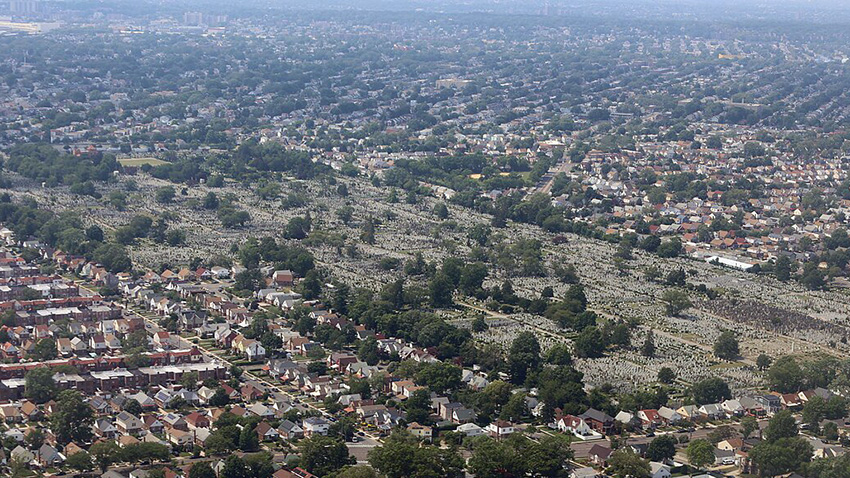
And now Ari and I are driving to this same brother’s burial, somewhere in Long Island, somewhere past billboards announcing a general “we” who supports the troops and signs for at least five different cemeteries. I don’t know if there’s actually anyone living in this part of Long Island.
When we get to Montefiore Cemetery, we pull onto a side street, looking out for the right caravan of cars pulled up along the main drag that leads into the burial ground. We see no familiar cars, and so while we wait, I ask “Should we visit Sadie while we’re here?”
Sadie is—was—is?—Ari’s aunt, who died five years ag0, the night before she was supposed to come home from post-surgical rehab. At dinner, hours earlier, Ari’s mother had told me, “She’s not getting better and I don’t know what’s going to be when she comes home.”
And then the phone rang at sometime after two that morning. And then Sadie was dead.
It was the last day of Pesach. We couldn’t drive. And we couldn’t get the burial service on the phone, even though preparing dead bodies for burial supersedes the restrictions of holiday observance.
Jews don’t leave their dead alone. Borne out of a medieval fear of desecration, we watch over our dead until they are buried, safeguarding them from rodents, body snatchers, and other forms of danger that persist even after the deceased are long past caring.
The afternoon after Sadie died we walked from Flatbush to Chaim Solomon, the Sheepshead’s Bay nursing home, for our shift in the vigil over her body that would end with the holiday that night. I didn’t know Sheepshead Bay was walkable from Midwood until that morning. It didn’t even occur to me that Sheepshead Bay was literally a bay until I noticed the number of gulls milling about in sleepy intersections.
When we passed the nurses’ station, we got sad looks from the nurses sitting at the semicircular desk. I heard a sniffle from a man in scrubs standing in the back and realized he must have been the nurse Sadie was particularly attached to, the one she would gift candy and dried fruit baskets every Christmas for the past five years, even the odd year she happened to be home.
“You can go ahead,” one nurse said, probably unnecessarily.
The door to the room was closed and we looked at each other briefly, wondering if we should knock. Ari went for the open-the-door-slightly-stick-your-head-partially-through-the-door-and-knock approach. It’s a relatively useless gesture, to acknowledge your intrusion just before letting your whole body in the room.
We were there to relieve his brothers, who were sitting in poorly filled, polyester-covered chairs they had pulled into the short hallway, trying to give the body a respectful distance in a room that didn’t really allow for it. The window blinds were drawn to prevent the sun from hitting the body and there were box fans lining the window ledge. The filtered sunlight and off-white walls made the room feel sallow. Someone had draped a thin sheet over Sadie’s body. The fabric quivered under the fan air and throughout the day I sometimes thought her toe was moving.
The younger brother left and the older stayed for reasons I couldn’t fully understand among the insistences, apologies, and haphazard expressions of concern and politeness that the three brothers exchanged in excruciating awkwardness.
And then we sat in relative quiet. We made small talk. We laughed at a callously morbid remark before one of us glanced at Sadie, and we went silent.
An hour later we heard a knock and looked at each other, as though we couldn’t decide who would be knocking and what we should say. But it was only a nurse checking in.
Another hour later there was another knock, and we said “come in” casually, assuming it was the nurse again.
But it wasn’t a nurse.
It was a girl who couldn’t have been more than ten. She wore a light blue sweater over a frilly blouse, a black skirt, black tights, and black flats. There were at least five girls crowded behind her between the ages of eight and eleven, small frizzy bits of hair haloed around their heads and tops of their scrunchies. Their cheeks were ruddy from the wind and maybe some mild shyness. They started a chorus of “chag sameach” and “ow” as they wished us a happy holiday while stepping on each other’s feet and waited for their leader to open the door wider.
Blue Sweater bent an eyebrow at us, confused as to why three adults were sitting in the hallway, feet away from the patient’s bed, and with our backs to her.
I wondered if she could see Sadie’s sheet-covered legs behind me. I wondered if you could tell that a person was dead from her toes.
After she dismissed her initial confusion, Blue Sweater said “We’re here for bikkur cholim. Is she up for a visit?” Even as she asked, they started to come in, assuming Sadie would love to see them, assuming that even if Sadie was sleeping she’d want to be woken up. She wouldn’t want to miss the girls.
Which would have been true.
The dance that followed was madness. The three of us half flew out of our chairs, waving our arms, because we didn’t know what to say to the earnest, clueless children. Ari’s brother finally thought to say, “She really needs her rest.”
They nodded in the worldly understanding they think they’d earned from their visits to the sick and elderly. They wished a refuah shleima and left.
That might have been the closest they have ever come to death and they didn’t even know it.
The holiday ended that night and Ari’s father drove to the nursing home with suitcases, duffel bags, and empty shopping bags to pack away her clothes, her toiletries, her sundry belongings, her romance novels: all everyday, nondescript objects that had become mementos literally overnight.
But today we aren’t at the cemetery to visit Sadie. We are there to watch others bury my uncle. The man I didn’t know. The man I heard more about at his funeral than in my thirty-four years on this Earth. The man who changed his last name to sound less Jewish, which would eventually prompt far too many invasive questions during shiva.
The first time I saw my cousin in over a decade was when they escorted the body out of the funeral home. When he passed me, he leaned in to hug me. And I stepped on his toes.
And then I said: “Oh, like you haven’t been through enough. And now I step on your toes.”
I turned to introduce myself to his new wife and she looked at me like I had a couple of extra heads. And none of them were styled appropriately for the occasion.
I feel my phone vibrating in my lap, and see that it’s my father calling.
“Hello?”
“Hyeello.” He does not sound quite so much like he is about to bury his brother. I hear his sister say hello in the background, too. “Where are you?”
“On a side street, facing the main drive. We see cars piling up. Is that you?”
“We’re all the way in the back, but I guess it’s us. Though it’s a Sunday. It might be busy.”
“Dad, it’s a Jewish cemetery, it’s not like people hold off for Sunday funerals.” We don’t leave the dead alone. And we get them in the ground as soon as possible.
“Well —” He’s about to argue with me. I just know it. I don’t know how but he’ll find a way. So I cut him off.
“Okayseeyousoonbye!”
We wait until a car stops to let us in. I can’t blame cars for ignoring us; it’s risky to lose your group in a cemetery.
Once we’re let into the melange of processions, we drive down the main street and follow the cars around the traffic circle, which leads to the grid-like blocks of plots beyond. But when we get to the end of the roundabout, we’re cut off. A man stops the line to let an excavator drive past. By the time it clears, the cars ahead have dispersed down several of the different streets that run out of the traffic circle.
This means two things: 1. We don’t know where we’re going, and 2. The cars we were following were not all part of the same processional.
We’ve lost our people.
Two cemetery blocks ahead, I see a group assembled around a new grave that looks like the same people we left at the funeral home in Minneola. It’s a combination of bottle-blonde women in black, sleeveless dresses and sunglasses; men in shirtsleeves and kippahs standing next to women in wigs and hats; and one or two men in full, dark suits and black hats. It looks like the religious confusion that matches most gatherings of my extended family and their respective communities and chosen families.
We park and walk toward the gathering. But I don’t know these people. And not in the sense that I feel alienated from my extended family and my own religion. This, of course, is true.
But that’s not what I mean here.
I literally don’t know these people.
Wrong bottle-blondes. Wrong men in suits and black hats.
I’m standing a handful of yards away from a group of people I don’t know who are burying their loved one and staring indignantly at them because they are the wrong people burying their loved one.
I turn around, get back in the car, and call my dad again.
“Hello?”
“Where are you?”
“I don’t know. Where are you?”
“What do you mean you don’t know?” I expect my father to just know the location of his brother’s body. Like there exists some form of psychic, cross-mortal-plane, sibling lo-jack.
I also just assume that as the adult he should be better at following funeral processions.
“Well, we’re somewhere around Maimonides and Fourth,” he says talking about intersections in a cemetery like we were in midtown Manhattan and I know what that means.
“Okay, is that where his grave is?”
“I don’t know.”
“But what do you mean you don’t know?” I let my head fall in my lap and talk into my skirt.
“We lost the procession. Where are you?”
“Why does that matter?” I scream into my lap and hang up the phone.
I hear the car door open and without lifting my head out of my lap, I give him my dad’s semi-helpful instructions to somewhere we didn’t need to be, and a few choice words that sound something like “Mmmmffwaaaer.”
We turn down the avenue and drive back toward the main entrance, back toward “Fourth,” and then he puts the car in park.
“Do you see them?” I ask, trying to understand why we’ve parked.
“No.”
“No?”
“I think it makes sense to park here and walk to find them. You said your dad was at Fourth and Maimonides, right?”
“Yes, but I also said he didn’t know where everyone was.”
“Okay, but they’re probably near here, right?”
“That seems like an odd thing to assume.”
“Let’s try it.”
“Fine,” I say, unbuckling my seatbelt.
I walk further down Fourth, wondering why it is I’m walking and not driving at a faster pace, but also too resentful to turn around and tell him so.
And then I see in the distance:
Bottle-blondes.
Sleeveless black dresses.
Wigs.
Long skirts.
Black hats.
All looking solemn around a grave without a headstone.
My people.
I’m jogging as much as shapewear, heels, and a weak-willed bra allow. And as I’m walking further into the groups of gravestones off of Fourth, I see it. Again.
Wrong bottle blondes.
Wrong wigs.
Wrong black hats.
Wrong people.
And this is the first and only time I come close to crying on the day of my uncle’s funeral. Tears of frustration mix with the eye makeup I brazenly wore that day, confident I would not shed the tears that usually preclude mascara’s inclusion in a funeral ensemble.
I had not prepared for the emotions that come from getting lost in a cemetery.
My phone buzzes again as I walk back to the car. Dad.
“Hello?” I realize too late that I’m yelling in the middle of a cemetery, just yards away from the wrong burial.
“Where are you?” Dad’s yelling, too, but in the way he always does when his phone is hooked to his car’s bluetooth: like he was calling another dimension on a crappy line.
“Not this again,” I sigh, not sure if he heard me. “I’m somewhere in a cemetery. Where are you?”
“We’re on First and Lincoln.”
“Is the rest of the funeral there with you?”
“Yes.”
“The right funeral?”
“What?”
“Never mind, I’ll be right there.”
When we get to the burial, we stand at the edge of the gathering, with the right bottle blonde women in black sleeveless dresses, the right bewigged women in knee-covered skirts, and the right men in black hats.
As I watch relatives throw dirt on the grave, I remember the old family lore that when they were all in their twenties, my mother had thrown a table at my uncle.
“I only overturned it in his general direction,” she had modestly corrected.
The burial ends with lots of meaningful handholding, pats on the back, full hugs, and awkward waves for the more Covid-conscious. Everyone is walking toward their cars, asking if we would follow back to the shiva house, my parents’ house.
But we had decided to “visit” Sadie and the rest of Ari’s extended family resting in the same cemetery.
It felt like the thing to do.
We make our goodbyes, and I’m relieved that no one on either side of the family rift is pretending we should take this death as a prompt to be closer. At least there is the subtle agreement on all sides not to make this moment more than it is.
When I turn back to Ari, he is hanging up the phone. He nods at me, and we make our way to the car.
“Do you know where you’re going?”
“Yep.”
Well, at least this time we wouldn’t get lost.
“What’s the intersection?” I ask him.
“Maccabee and Fourth.”
“Okay, straight and to the right,” I say with confidence that can only come from knowing a place through first getting lost in it.
But when we park the car, we see a new problem.
An intersection is four points. Four points. Four blocks. And who knows how many graves in each.
“Any idea where to go from here?”
“Nope.”
“Fabulous.”
A pause, and then he asks, “Does anything look familiar?”
I think back to Sadie’s funeral. I remember standing off to the side with his mother. She had walked into a clearing the dead had yet to claim, her back to the grave, unable to watch them lower her sister into the ground.
She had sighed, looked up to the sky, and then leaned forward and buttoned my coat.
“It’s nice here, right?”
I looked out over the trees that lined the edge of the plot and saw what must have been a large hill—I never thought of Long Island as having mountains—and said, “I like the view.” And now we’re back here, and I look up, trying to remember the angle of my view of the hill that wasn’t a mountain.
“I think this way,” I say pointing to the block that seems to have the clearest view of the not-mountain. “Do you remember any defining features?”
“Sadie’s gravestone is pink.”
“Of course it is.”
We wander together through the first block and I grow increasingly irritated in the high frequency of Cohns and the absence of any Cohens. Just as I think I’ve found a lost family member, I notice the missing letter and catch the premature victory announcement on my tongue.
We try to beeline for the pink gravestones, but there aren’t many and some are hidden among their taller neighbors. Nothing.
“I guess we should try another block?” he suggests.
“I could have sworn it—she—was here!”
“But, why?”
“Because the not-mountain! And there was a giant clearing like that one!” I gesture wildly behind me, arms flailing like a muppet, at the clearing that looked so familiar.
“That was five years ago.”
“Yes.”
“Do you know how many people have died in the last five years?”
“Wow.”
“Yes.”
“Dark.”
“Right?”
“So what you’re saying is, maybe we shouldn’t go by sight memory?”
“Yes.”
“Fine,” I say after a begrudging pause. “On to the next block.”
And we look through the next block at the intersection.
“This is too crowded. And we’re too close to the middle of the not-mountain. And stop looking at me like that.”
He turns away as I finish that last bit like he wasn’t looking at me this whole time, judging my commitment to the view of the not-mountain. And we walk through the collection of memories of this land that we only partially recognize.
Cemeteries are equal parts intimate and generic. An impersonal, standardized organization that masks the pain and resentment that I have been holding in equal measure for the hour I’ve been on the land containing the bodies of people I know well and people I should know but are complete strangers.
In the places that are not too crowded, headstones are lined in parallel rows. But when space is tight, they deviate from the lines so that families who had paid for plots together can now be at rest together. Most of the stones come up to my chest: most are light gray. The most common art above the epitaphs are Stars of David and pictures of lions standing bipedal. The epitaphs largely list family positions the deceased had served in their lifetimes: fathers, grandmothers, aunts. When I see “son” or “daughter” listed, I glance up to the years the person lived to see if their time on this earth wasn’t long and wonder if their parents had outlived them.
A small, dirt-encrusted stone reads that an unnamed “Beloved Baby” lived for under a year in the 1950s.
Most of the larger stones included passages from Tehillim or Chumash. The women’s were largely all from “Aishet Chayil.”
The groupings of names feel like a bad Jewish joke. They’re all various combinations of the usual prefixes—Gold-, Bern-, Weiss-, or Katz—paired with the usual suffixes—berg, -stein, or -feld. A bot could have been asked to generate a hundred Jewish last names and it would have produced the same collection represented on the gravestones of Maccabee and Fourth.
But of course the name “Sarah Goldstein” may be synonymous with “generic Jewish name,” but there is someone walking the Earth who feels the loss of this Sarah Goldstein. Or of the other fifty Sarah Goldsteins I think I’ve walked past in the last five minutes.
Everything feels meaninglessly standard and deeply personal.
I see the almost cartoonish gleam off of some grey-white granite, but no pink. We’ve walked through three blocks already. Process of elimination would dictate that his family be on this, the last block.
So we look.
My feet are hurting. I thought I had chosen shoes logically: wear thicker heels that don’t get stuck in grass; wear heels that are comfy if you’re standing for a couple of hours.
No one had ever taught me to pick shoes that would support my arches for when I got lost in the cemetery.
Twice.
No one ever warned me that I would have to walk a mile in a graveyard.
Twice.
But here we are: surrounded by Freuds and Freunds, Frieds and Freids, and every Cohn who had died in the tristate area in the last century whose name looks maddeningly like Cohen.
In senior year of high school, we went on a community service trip to clean a neglected graveyard in State Island. A friend and I confronted mortality through “catching up” the deceased on the world they missed since their death dates. We collected empty soda cans and dead leaves in garbage bags and told the dead about the world wars, cell phones, and Titanic.
“The movie,” we specified, glancing at their death dates in the mid 1920s. “You’ve probably already heard about the boat.”
But I don’t talk to the dead today. I stew. I don’t know what to do with my aching arches, my sweat-logged makeup, my husband’s missing dead relations.
We are now standing in the street. We lock eyes knowing that we have come to the same realization. His father had gotten the streets wrong.
Process of elimination only works if you know what you’re eliminating.
“We could just go.” He knows I’m anxious. This was meant to be a short visit before we went back to my parents’ house.
Every tendon in my body is burning with effort, and I can no longer feel the balls of my feet. We lock eyes again and I can see his raised eyebrow even though he’s still a few yard away.
And I kick off my boots and walk down the aisles of graves in my stockinged feet.
No one has ever felt this much euphoria in a graveyard.
The dirt is sandy and covered in well-maintained grass. It feels almost like carpeting but the blades are pointed and they cushion, massage, and tickle the bottom of my feet simultaneously. My tights are thick enough not to tear from the spiky blades.
My eyes are closed, and I feel the sun on my face. My toes curl into the grass. I am no longer thinking about looking or giving up, or the week of watching my father sit shiva that will follow this minute.
I never want this feeling to end.
I could walk here forever.
But then he taps me on the shoulder.
“Enjoying yourself?”
I tell him no in a three-note song of denial. “Any luck?”
“Well, I found the Pretzel-Cohn-Schweibermans!”
“Of the Connecticut Pretzel-Cohn-Schweibermans?”
“Obviously.”
A moment of quiet. He looks down at my feet, then to my boots in my hands, and raises an eyebrow. I fold my toes deeper into the grass and look him in the eye, daring him to tell me I’ve done something strange.
“No luck here I take it?” he asks, sidestepping the obvious.
“Nope. Shall we keep looking?”
“Let’s.” He extends his arm in an after-you gesture and I turn around, lightly stepping down an aisle in between gravestones. He chooses one row down from me and we mosey through the block, turning occasionally to check on the other over the waist-high stones.
There is a strange intimacy in searching for one’s relatives in a graveyard: in the shared history of the moment, in the stories he told me of relatives I never met, in our memories of Sadie, in the time we spent together in this cemetery, in his total lack of surprise that I took off my shoes in a graveyard.
In our shared knowledge that the Pretzel-Cohn-Schweibermans are buried a few yards away.
“I think I’m ready to pack it in,” he says, clearly tired and slightly sun-baked even though it’s early October. I bite down on my lower lip, and along with it my obstinate refusal.
“Why don’t I get the car and you just take one last look?” he offers, knowing how little I want to give in.
I agree, and we part ways.
I can’t say how I know that the grouping I approach next will be the one. Or how it came to be that the crowd of gravestones have across time gathered prearranged in such a way that I can see a shock of pink granite in the gaps when I stand at the grassy northwest corner of the block.
“Hi Sadie,” I say softly, emboldened by knowing there’s no one in earshot and by my relief in finally finding “Anne Sadie Cohen” engraved in the pink stone.
She is listed as “Beloved daughter, sister, and aunt” below that. “Piha patcha b’chachma, v’torat chessed al leshona,” a line from Aishet Chayil. Her mouth opens with wisdom and kindness of the torah sits on her tongue. The same line is on my Bubby’s gravestone in New Jersey.
It’s the line somewhat ironically given to all mouthy Jewish women.
I smile at Sadie—or at her stone—in part because I don’t really know what I should do now, but mostly because I am so proud that I found her that I need to do something with my body. And dancing feels inappropriate.
I think to tell Sadie what she’s missed, but it doesn’t feel comforting now to think of the five years without her.
So instead, I shuffle my stockinged toes around the dry dirt near the grave, looking for a rock that’s more than a pebble-chip. I kick around one about the size of my thumbnail. Putting it on the top of the gravestone, I wonder if that’s why we have this ritual. It’s something to do around loved ones who can’t talk back.
I hunt for rocks for the other Cohen graves around her: the grandmother who died while we were engaged but I had never met, the grandfather who died six months before our first date, the great-uncle and great-aunt who died when he was in high school but are the reasons why the first Hungarian words I learned were “aunt” and “uncle.” I only now learn Bácsi’s and Néni’s names when I see them in front of me, engraved.
I think how this is the quietest family gathering I’d ever attended.
I see him pull up in the car and wave to him, signaling he should come over. With a grin that I knew was wildly inappropriate, I say “I found them.”
“I can see that.”
I wait, expecting something more. I want confirmation. Validation. Congratulations.
I want a fucking treat, if I’m being honest.
He reaches behind me and itches my lower back, and I arch my shoulders like a sunbathing cat.
Good enough.
He moves his hand away and looks through the dirt for rocks, muttering that I had taken all the good ones. And once he places his pebbles next to my grown-up rocks we stand there quietly.
We don’t pray. We don’t talk. We just stand there.
And then after a five-minute-long ninety seconds, I break the silence. “Now what?”
“I don’t really know.”
When we would get back to my parents’ house two hours later, we would avail ourselves of bagel-lunch-turned dinner, combing through the fridge for hastily saran-wrapped plastic trays holding various salad platters, and tubs of tuna, egg salad, and a browning avocado mush. He would pull out a tiny condiment takeout cup containing one peeled, hardboiled egg. “Is this for someone to eat?” he’d ask. “I think the egg is for the mourners,” I’d say. It’s a round food reminiscent of other days of cultural mourning. Humble and representative of life’s cyclical nature. I don’t know if I’m right. My knowledge of religious custom always seems hazy just in the moment I need it. It would sound right, so I’d say it anyway.
But for now , it is two hours after my uncle’s burial. And I am no longer lost in a cemetery. And I don’t know what sounds right to do next to Sadie’s grave.
“Time to go?” he asks.
“But we just got here.”
“What else do you want to do?”
“We’ve been looking for them for an hour!”
“What else do you want to do?”
And I look at Sadie, absorbing the pink of her gravestone, her name, the phrase from “Aishet Chayil” for mouthy Jewish women.
“It’s time to go,” I say. And as we walk back to the car together, I keep my head down, careful to make sure I step in places where it is safe to tread without shoes.
Kate Schnur is a writer based in Bronx, New York, where she lives with her family and house plants she hasn’t yet accidentally murdered. She teaches literature and composition at Queens College, City University of New York. Her work has appeared in Electric Literature, Women’s Studies Quarterly, Medical Humanities, and Modern Fiction Studies.