
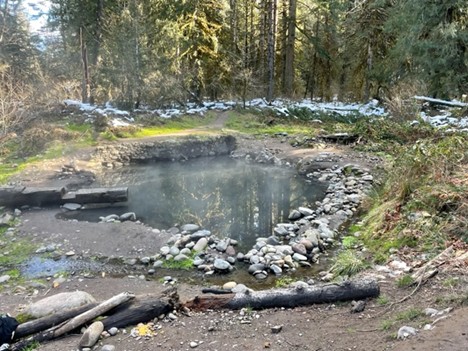
Photos and Drawings by Eve Müller and Kelly Terwilliger.
NOTE: This is an excerpt from a collaborative, book-length work (Water Questions) based on a series of 12 swims – one a month – in a different body of wild Oregon water. The authors fully immersed themselves in the water both by skinny dipping and researching the natural and human histories of each place. Their third swim was at McCredie Hot Springs.
Kelly
A clear day, after bouts of snow and rain, sleet and hail.
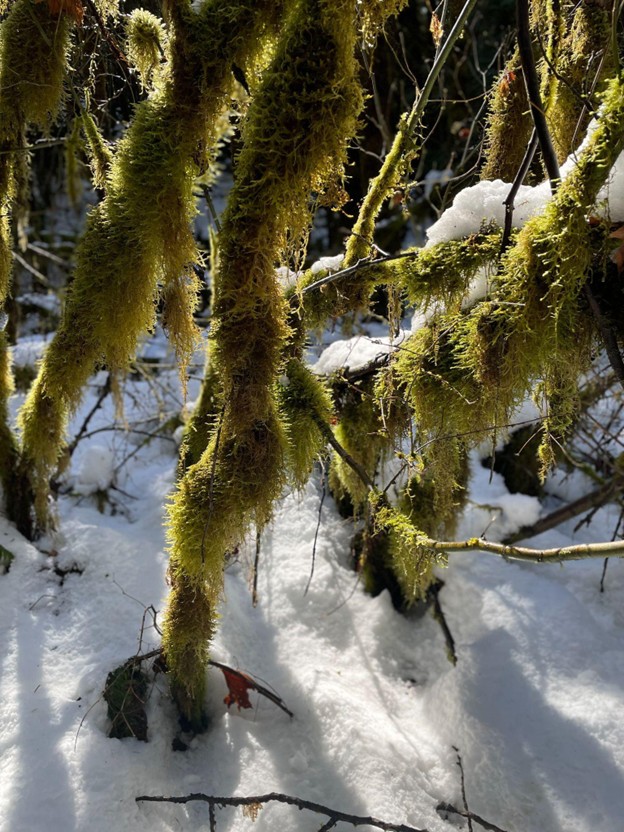
The woods were all crystalline and moss, bodies of trees
adorned in green, standing in white,
everything sparkling, hushed,
like a portal to another realm.
Slippery, a hint of peril—
roots and mud, and ice
skittering and sliding, the corridor of winter
a test a traveler must traverse
in order to enter—
What? The pool. Wide-ish, shallow-ish.
Not exactly beautiful.
Muddy. Gritty. Silty-gray.
The pale naked bodies of two
men already drifting in it,
six not-naked twenty-somethings in a pool farther down.
Was this it? Just this?
Heat came up from the earth. Steam rose into the cold.
The air was full of quiet wraiths.
And when the sun shone through the steamy plumes,
you were wreathed in it.
We joined the naked men,
the quiet one resting his head on his hands on a rock as he dozed.
A solitary animal sleeping naked in a pool in the woods.
The other flapped around, a man wanting
to transform himself and his life
but not knowing how, or what kind of being
he should become.
When the young people finished their soaking
they fretted as they changed
their clothes, hiding their bodies
in elaborate awkwardness.
This, in front of a pool of naked people.
Perhaps they didn’t notice us.
Perhaps they pretended we weren’t there.
Perhaps our bodies simply didn’t matter—
their own in this moment so potent, risky, uncertain.
We lay quiet, murky with silt and sediment,
pulling away from bursts of hot
shooting up from the muddy floor
like little biting teeth.
The mud and silt did not feel dirty
just part of the pool, mineral.
Soft clouds pillowing up. Small grit under my palms.
Most of it so delicate I barely felt it settle on my skin.
Solution, dissolution, solve, dissolve.
Us, in the soup of it.
For a long time, happy in the lappy heat
we basked in bubbles and silt.
Eve
When it comes to nature, I’m greedy:
Sword ferns bursting through snow hillocks.
Pale moss amidst banks of blinding white.
Vapor rising from pools.
A hazy nimbus of sunlight shrouding our heads.
You, glasses glittering, diamond-eyed.
I didn’t want to share it with strangers.
When we first arrived at the hot springs,
and realized we were not alone,
my heart snapped shut.
Not so hard as stone, but no longer open as water.
Nor were the springs as beautiful as I wanted them to be.
Pond scum and the leavings of others –
plastic bags, tumbled undergarments –
littered the shore.
The awkward sounds of sexual courtship: towels snapping
young women shrieking in mock horror,
young men vying for their attention –
carried across the water.
Someone was drinking Coke from a can.
I confess I hated it.
And I felt ashamed of hating it.
Why does imperfect beauty enrage me?
Why must I be so difficult?
But as we eased into the ooze of mud and steam,
I felt something akin to church.
I didn’t need the two men for my experience to be complete,
but recognized they were seeking the same thing we were.
I settled into these springs in a way I could not
for our earlier swims.
When the water was cold, I’d focused on “not-dying,”
on warming the husk of my body,
remembering to breathe.
The water – warm now – I no longer scrabbled to
master unforgiving landscape.
I shut my eyes and we were ancient animals wallowing,
rippled water the color of clay,
our animal lungs sighing like bellows,
a gentle shifting of trunks, paws, haunches.
Yes, I noticed the man who seemed to need us,
his fleshy paunch,
his palpable wish to be a part of what you and I were sharing.
What was it we were sharing?
Words about words,
the point at which truth spills over into untruth,
whose stories belong to whom.
Did you worry the water was dangerous?
It was hot enough to startle us,
as it bubbled up from the mud,
to sting our bottoms sharp and swift as the bite of a horsefly
yet not enough to harm us.
More dangerous, perhaps, to be out in the world –
naked and aging.
Adrift without clothes, in full view of strangers,
our breasts and bellies mushroom-soft, marked by time.
Let them ignore us.
Let them judge and find us wanting.
Our bodies were covered in layers of silt.
When cloud shadows moved across the water’s surface,
our skins seemed part of earth and sky.
We briefly belonged to the world of
plants, animals, sulfur, steam.
Its amorality and innocence were ours.
Eddies
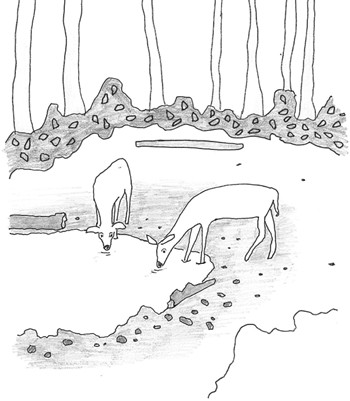
The McCredie Hot Springs lie along Salt Creek, a tributary of the Middle Fork of the Willamette River that tumbles down from Willamette Pass. Salt Creek gets its name from a series of salty springs downstream from Salt Creek Falls…possibly the McCredie springs are some of them. We didn’t think to taste the water when we were there. It had naked people floating around in it. It did not look…tasty. But apparently animals use the salty springs as salt licks when people aren’t around.
Written history of McCredie Hot Springs starts with white settlers – not with the Native Americans who surely knew about the springs for centuries. In 1878, a trapper named Frank stumbled upon the string of pools and built a cabin beside them where he lived – and no doubt soaked – until booted out by the US Forest Service. A man named John built a hotel on the land in 1914, followed by Judge McCredie who built a resort. The railroad started servicing the resort in the 1920s, and by the early thirties, five trains a day carried hordes of bathers to the springs. But in the 1940s, a new owner converted the hotel and resort into a bordello, spoiling the hot springs’ wholesome, therapeutic image. Fires and floods in the fifties and sixties destroyed all the remaining structures associated with the spa/brothel and returned the springs to the more natural state we find today: Hot water burbling up in pools beside a river, with bits of trash and hikers’ muddy tracks.
I chafe at place names that have nothing to do with the place, only with some person who wanted to lay claim there. McCredie? Why his name? Wouldn’t Siltwater Hot Springs be more appropriate? Or Beside the River Hot Springs?
I’m one to talk—there’s a Terwilliger Hot Springs not far from here. And honestly, it’s kind of fun feeling even superficially connected to a hot spring. But I still think another name would be better.
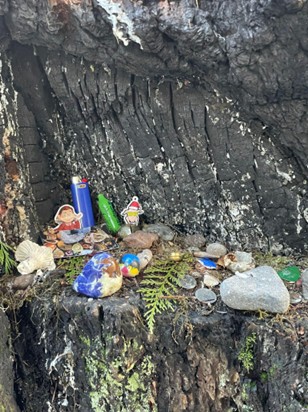
Are there stories of spiritual beings related to McCredie Hot Springs? We don’t know them, can’t find them. Sulis, goddess of the thermal springs at Bath, England, regularly received offerings: More than 12,000 Roman coins have been recovered from the baths, as well as 130 curse tablets, jewelry, gemstones, serving dishes, leather, and wooden objects. Well into the 1990s, people were still dropping offerings into the waters of Bath. We are such a messy species, even in expressions of devotion! Why is it so hard for us to visit places without leaving human marks behind?
Hot springs are heated by geothermal energy from deep within the earth. Water emerges from the ground in short, hot bursts, at a temperature of 163 degrees. The water here is hot!
All this heat invites basking and longer water visits. We spend more than an hour in McCredie’s steaming pools – much longer than the minutes—or seconds – we spent in the wintery waters of Cleawox Lake and the Willamette River.
At first, I flail about. Uncomfortable and even a little angry. Troubled by the human stain.
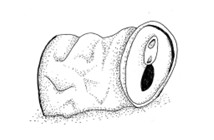
We like pristine places. But lots of people do. Why should we be the ones to have them all to ourselves? And aren’t we pleased that other people cherish the things we do? The trouble is, with lots of people, trammeling gets harder to avoid no matter how delicately we place our feet. We too are animals at the watering hole. Our feet add to the McCredie muddiness.
It was not exactly beautiful. And yet it became more so the longer we stayed. Was it beauty? Or was it intimacy, a kind of appreciation that emerges when we sit with a place long enough?
There are places so wounded, so damaged, that no amount of looking can lessen the pain of them. But there can still be connection. We often do look away from the soggy wrapper, the discarded diaper. But when we see them, we can also pick them up. Do some repair.
When a body of water is both littered and wild
do we ignore the unbeautiful, or do we find a way to hold it?
Can we settle into this place on its own terms?
We settled into the hot springs. To settle: come to rest or sink gradually to the bottom. We settled into the sediment at the base of the pool. Entering the spring, we stirred up scum and debris, and it took several minutes for the water to become clear again. To settle is to be content, and after a time, we were. But settling also means to take up a stable, orderly life, establish residence, or – more darkly – to colonize a place. We are only passing through McCredie Hot Springs, but what does it mean to be part of a long line of even temporary settlers?
This is the first place we share the water with others. Not simply as distant specks, but as fellow bodies, with soft animal flesh like our own. We bask together in heat and steam. We are weirdly intimate. Our bodies naked in this same warm, silty water. But only for the time we drift together. After that, we’re back to being strangers.
There’s a visceral thrill when I take my clothes off outside. I’ve never sought out physical risk. I don’t much care for danger. But stripping down to bare skin – with only a thin membrane between me and everything else – I find exciting. A naked, middle-aged woman stumbling over stones, flesh trembling with each step, exposing her lived-in body to the critical gaze of others.
Being naked here with strangers – and with men especially, their eyes summing up our bodies – feels different from being naked alone or naked just with you. When we’re alone – as we were at the Willamette River – being just a body feels liberating: My flesh unsymboled like the hawk you wrote about. My skin a source of fierce sensation. But when others are around, I feel vulnerable and soft as something found beneath a log.
I didn’t have to wonder in this place if skinny-dipping would offend, disturb, or cause dismay. Naked was acceptable, and in the pool I was a creature of the pool.
But I did cover myself when I got out.
I felt a different kind of togetherness with you in this place. If I had been alone, would I have stripped down and gone in with these strangers? Maybe. Maybe not. With you there, I felt no hesitation. The delicate dynamic of assessing risk changes when there are two of us.
It felt good to be a we.
One man left quietly without saying goodbye. The other man needed us. He needed us as women. Not as sexual beings, but as sources of nurturance and validation. We found this man exhausting.
Hot springs often serve as communal spaces where people gather to relax and heal, not as a way to escape society, but to find it. The thermae of Ancient Rome were central to hygiene, but also to keeping up on politics and gossip. Turkish baths, or hammams, were adopted from the Romans, and are seen as a place to gather and cleanse before prayer. In Japanese culture, the onsen also offers a coming together to cleanse not just dirty bodies, but also impure minds and souls.
It was not technically an onsen, the one I entered in Kyoto. It was a sento, a public bathhouse. All women. All naked. All shapes and sizes. All ages. Soaking was communal, but I found the washing most intimate. Women all around, seated next to faucets, soaping themselves, washing their hair, their breasts, their armpits, between their legs, their feet…women pouring water over themselves. A gentleness.
I have never felt so publicly comfortable in my body. There was no shame, anywhere. We were human bodies, body beings. Being alive.
to bathe
wash by immersing oneself or another in water
moisten, wet, soak
wipe gently with liquid to clean or soothe
flow along the edge of something
spend time in a body of water for pleasure
to be suffused or enveloped in light or emotion
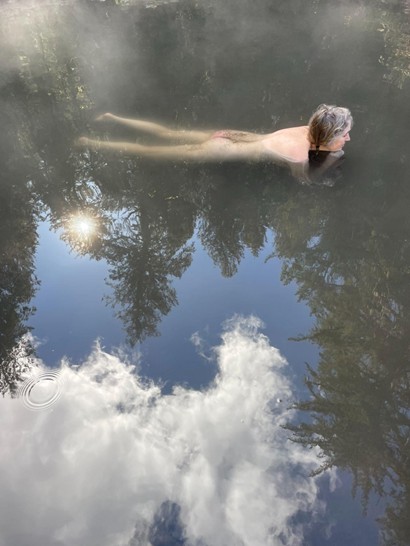
We take pictures of each other’s bodies. We are still a bit shy. Afraid to violate the other’s privacy. I like the one where I float face down – bare bottom and legs drifting and silt-limned. The surface a mirror reflecting fir trees and fat puffs of cloud. My body swimming in sky.
We are lounging in a second, cooler pool, when the needy man wanders over and offers to take our picture. His belly is slack as an old pillow and bristling with hair. I find his body both funny and sad – similar to my own body. I decide to forgive him for wanting something from us. The picture he takes is not very good, but we’re smiling as we squint into the sun. We look happy.
This swim: no longer two distinct people on a shared adventure. In the presence of others, we become us. Two friends in a pool together.
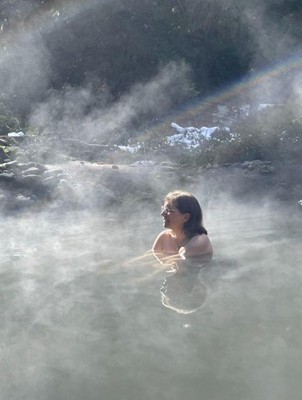
Eve Müller and Kelly Terwilliger have been writing and swimming in wild places together for the past three years. They continue to learn how to take risks, to push, encourage and inspire one another, and to relinquish ego in creative work. They are adept leave-no-trace skinny-dippers and careful co-inhabitants of the places they inhabit and celebrate. Excerpts of their work have been published by Colossus, McKenzie River Trust, and About Place. They have shared readings of Water Questions at literary retreats, artist residencies, an environmental organization event, and an art gallery featuring a showing of water paintings, and have been awarded residencies at PLAYA and Wupatki National Monument to work on their collaborations.