.jpg)
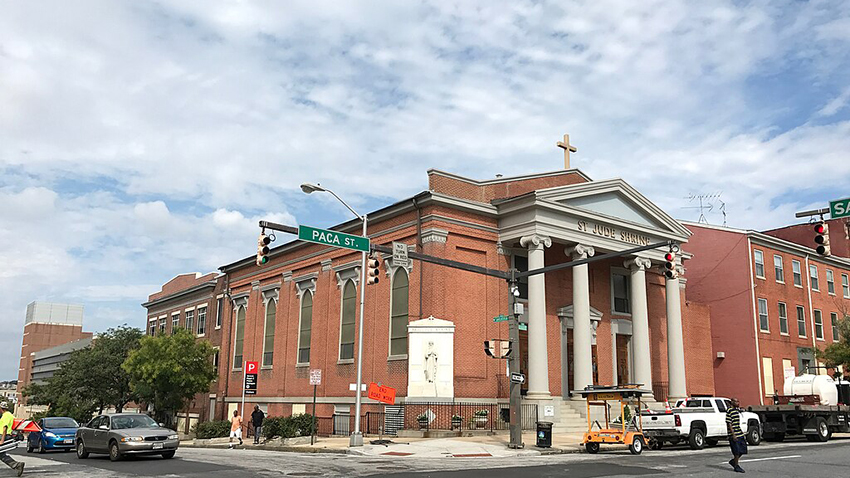
Every city has religious landmarks, places where the pious or curious can enter into. Some leave those places with a tangible reminder of their visit—a stone or card. Others leave with a funny taste in their mouth as the sacred has a flavour not found anywhere else. When I first visited Baltimore’s St. Jude’s shrine I left with neither although I keep visiting hoping that might change.
My first trip was during the summer when my daughter was attending a nearby theatre camp. The shrine is located on a charmed stretch of charm city next to the renovated Lexington market which sells seafood and produce along with cold brew coffee and locally produced ice cream. Nearby is the central branch of the Enoch Pratt library. Edgar Allen Poe lies buried in a churchyard a few blocks away.
I entered the shrine not as a devotee but as someone looking to kill time and escape the brutal sun.
Catholics have saints for everything. There are saints for miners, comedians, florists, midwives. There are saints you can pray to if you are about to get struck by lighting or attacked by wild dogs. You can read about the their lives but to get a sense of their physicality you must look to statues or prayers cards. The saints more or less lovely depending on the devotion of the particular artist. Expect a certain otherworldliness along with flowing hair. Expect variations to the degrees of suffering in their faces. Expect hands: holding hands, beseeching hands, prayerful hands. Funny how Saint Jude always look the same no matter the artist. A bit like Jesus Christ himself with a beard and steady, clear-eyed gaze. Beaten to death by a mob Jude is usually pictured holding the club that killed him as if to drive home the point. Jude is rooted in the earthly now, the patron saint of hopeless cases. He’s the one you pray to when all else fails.
What makes the shrine a nationwide center for Jude devotees is is that matchstick slivers of his bones live here. Sometimes the bones are on display in a special case under a spotlight. Other times they are secured out of sight and you have to request to see them. Being in possession of Jude’s bones allows the shrine to claim the coveted first class relic status. First class relics include bits of the saint’s body while second class relics only include a shred of the saint’s clothing, the strap of their sandal. Those slivers of a saint’s bones changes everything. People will come from all over to see them.
The church is not huge like the nearby Basilica but just big enough to include a gift shop and pristine bathrooms. In the summer busses arrive bearing pilgrims who make devotions in a room filled with green candles meant to symbolise hope and renewal. They visit the gift shop where there is a wall of crucifixes and rows of colourful rosary beads. Bottles of blessed water from Lourdes meant to have healing powers can be purchased here. A baby archangel figurine stamps on another baby or is it Satan? beneath his tiny foot.
The pilgrims return to the waiting busses with their gifts. Maybe they have lunch at the Lexington Market before moving on to the grandeur of the Basilica. When they finally go home, I imagine their gifts are passed out to the sickest, most desperate, and I imagine their delight in receiving them. For me, for me? If I were still a believer in such things, I would gather the gifts to my body. I would let them dissolve beneath my tongue if possible.
Once, outside the gift shop, a woman took my hand and spoke to me in Spanish. I only half understood her. I will pray for you she said or My prayers have been answered! There was a time when I would have smiled uneasily and pulled my hand away. But I am older now and broken in unusual places. My devotion is half-hearted, lukewarm. I had no words to explain what I was doing in the shrine that summer morning or any morning. I had entered not as a pilgrim or devotee but more like a tourist. Someone who simply wanders and watches from afar.
Marylou Fusco is a Baltimore-based writer whose work has appeared in Carve, Five on the Fifth, Mutha, and the Greensboro Review. Her short fiction has won the Philadelphia City paper and literary journal, So to Speak’s fiction contests. She is the author support coordinator for Yellow Arrow Publishing, a nonprofit that supports female-identifying artists.