This is an excerpt from the travelogue Baltimore by Annie Marhefka, during which she visits the American Visionary Art Museum (AVAM). Order your copy from writerinsites.com.
First, I wander and I take no notes while I do, because I am here to be present, to experience art. I walk and wander, pausing when I feel moved, until I have procrastinated enough and let myself approach the garden.
A friend had suggested I look up “collaborative separation agreement.” She’d said, it sounds like you two are aligned. Might be a good option. At least while you’re still getting along. This is the kind of thing everyone kept saying to me. An assumption that at some point, we would not be getting along. That at some point, we would not be collaborative. I enter the garden portion of the museum, which is outside of course, between its two main buildings.
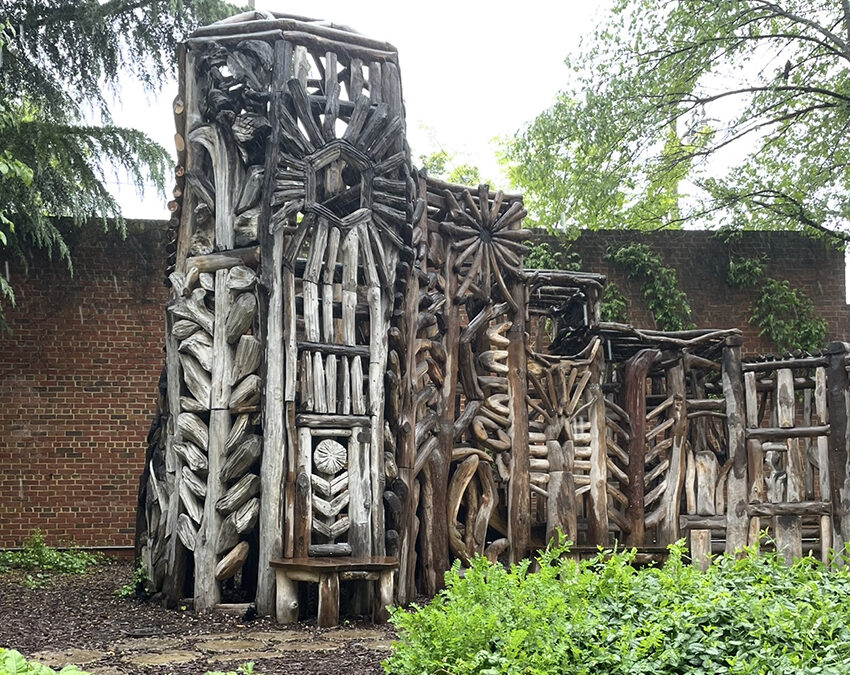
The largest sculpture in the garden looks like a tree fort—a carved wooden structure that reminded me of my childhood. When I saw a tree fort, I thought of my brothers—Richard, Herb. I thought of feeling safe. I thought of comfort. Comfort sounds a lot like safety, but it isn’t the same is it? Comfort is something that is unattainable unless you have safety. Comfort is what comes next. I wonder when was the last time I truly felt comfort.
There is a bench next to the wooden fort. I’d set my bouquet down here, during the wedding ceremony. Now I sit my body down here, a flower of a different variety. I take my phone out and search for “collaborative separation agreement.” The generative AI tool that has inserted itself in my web browser without permission returns a summary. He spits back that such an agreement emphasizes open communication, honesty, and problem-solving. I try to imagine a couple that has been successful at open communication, honesty, and problem- solving wanting to draft a separation agreement. But I realize, actually, my partner and I have excelled at those things together. That’s how we have gotten to this point so amicably, isn’t it? I openly communicated: I don’t trust that you care for me as a human anymore. I was honest: I feel like my importance to you is as a member of the household, tending to the children, tending to the chores. As if my value is only in folding the laundry or wiping the runny noses or planning the play dates. I have problem-solved us into this arrangement: I have run through the options, the potential solutions. The only way left is out.
My AI pal has more to say. He suggests that a collaborative separation agreement is more cost-effective and less emotionally damaging. I survey the garden, try to remember how much it had cost to rent it for the day. AVAM was more of a niche spot back then; perhaps the costs have risen. In our marriage, my value had dropped, not risen. This was a factor in my decision. I want to say that the marriage ended because we grew apart, but people demand more of me. They ask—but what happened? They insist that you name the factors. Out of curiosity, maybe. Some out of care. But many—as a way of protecting themselves, I think. Name the contributing factors, they demand, so that I can look for them in my own marriage. Before it is too late.
In the garden where we wed, I list the factors:
He stopped paying attention.
He acted like my writing was frivolous, a hobby. Acted resentful that it took time away from my
parenting.
He started using AI to communicate with me.
He stopped putting in effort.
I did not trust that he loved me any longer.
I longed for something else. When we were together, I felt more alone than
when we were apart.
In this garden, I do not feel alone with the thought of being alone. I feel safe with myself. I feel comfort.
Annie Marhefka is Executive Director at Yellow Arrow Publishing, a Baltimore-based nonprofit empowering women-identifying writers. Her first collection, Strangers We Know By Heart, was published by Garden Party Collective. When Annie is not writing, she is usually trying to find her way back to the water. Follow Annie on Instagram @anniemarhefka and at anniemarhefka.com.