

At the top of the multiple flights of escalators awaited a town that transported us hundreds of years into the past.
Nora had been talking about Toledo for months. Ever since we’d started planning the trip together, our first solo trip, and to Europe, no less, Toledo had been at the top of her list. And so, rising all too early in the morning, we’d taken the hour-long bus from Madrid to the historic town, ready to make my sister’s dreams come true.
I knew little about the town. Scratch that, I knew practically nothing about it. Nora had taken over planning the entire trip, even though it was my college graduation trip. I was happy to entrust her the reins, as she was clearly much more excited about it than I was. Not that I wasn’t excited to see Spain. I just preferred to tag along and let someone else do the planning.
As we stepped off the escalator, I grinned. Nora might have wanted to come here for herself, but it fit my love of anything medieval perfectly; I’d spent much of the last four years swinging a sword at my college friends. It was going to be much harder to find a place where that was socially acceptable, now that I was supposedly a full-grown adult.
“This is it,” Nora said. “Toledo.”
“Is this what it looks like in the show?” I grabbed a map of the town from a nearby booth and tucked it into my back pocket.
She looked around. “Maybe further in.”
While I’d been away at college, Nora had spent the last few years finishing up high school, beginning to date boys, and apparently, picking up a habit of watching Spanish TV shows. One of them, Toledo, cruce de destinos, had been a large part of the reason for our current trip. Nora needed to see where her favorite show had taken place, and where her beloved Martín, played by the dreamy blue-eyed Maxi Iglesias, had roamed the streets.
Having not watched the show, I knew very little about Martín, or any of the other characters, but I’d done my best to listen to Nora as she told me the general plot during the bus ride here.
The crowd led us further into Toledo and I eagerly followed them, Nora right behind me.
My ankles threatened to turn on the uneven cobblestones, and while the crowd headed down a wider street, several alleys turned down the sides. Stone buildings surrounded us, many of them housing charming shops. A restaurant, plenty of tables set outside, was poised and ready for lunch, while a small store across displayed impressive marzipan creations: everything from a palace to small musical instruments.
I didn’t like marzipan, otherwise, I would have stopped inside. Despite being a fan of nearly anything sweet, marzipan’s flavor was sickly on my tongue, the texture just slightly off, neither hard nor soft enough to be actually enjoyable. I’d quickly reached the conclusion that, like Turkish delights, marzipan was one of those things that just sounded and looked better than it tasted.
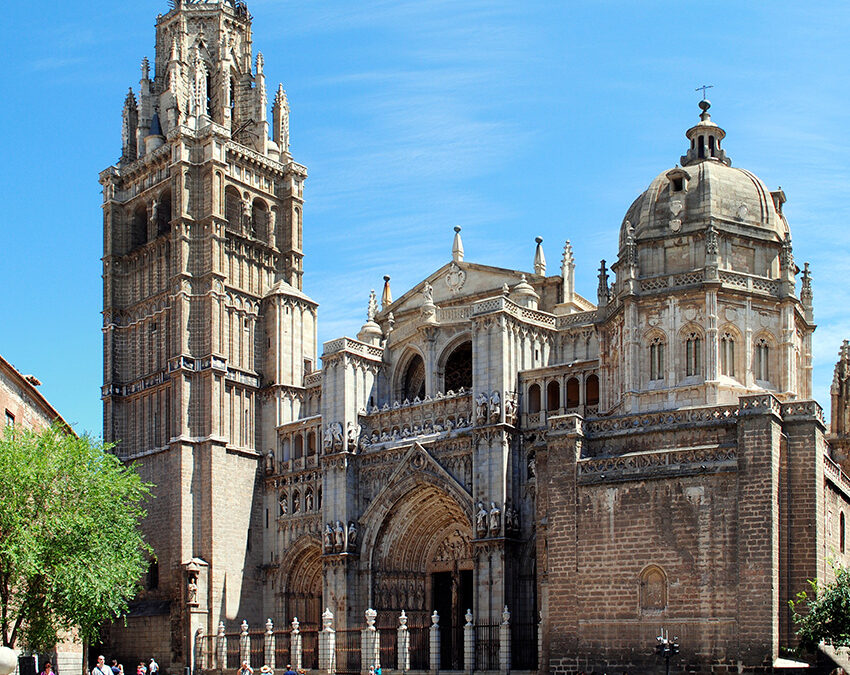
The crowd led us to the plaza, much wider than one would expect when the streets were so narrow. The cathedral stood tall at one end of it, dominating the entire size of the plaza. A tower reached into the sky on one side, connected to a shorter building with pointed arches and statues of more saints than I could recognize into every available niche. Scenes from the Bible were carved over its heavy wooden doors, welcoming penitents into its shade. Clouds crowded around the sun, forgetting that it was the middle of summer.
“Where do we start?” I asked Nora, looking up at the clouds. It wasn’t supposed to rain, but I’d brought the umbrella anyway. It was a hideous thing. Mom had bought it years ago: black and silver, striped like the world’s most gaudy zebra. It was big enough to protect both of us, though, even without standing close together. I’d hooked it onto my purse strap with its obnoxious hook.
“The cathedral,” she said. She didn’t look too happy.
I tried to picture Toledo, rather than seeing Toledo. No matter how much Nora had told me about the show, how many times I’d promised I would watch it, I hadn’t been able to find a spare moment to do so. Or, more like, I hadn’t been able to pull myself away from my own life for long enough to watch a show she loved so much.
Before I’d gone to college, I’d never had to “make time” to watch the shows she did, or her, to watch the ones I did. We watched everything together, sitting in front of the living room TV, tuning out Mom’s loud snores. We watched the same shows, read the same books, went to the same movies, ate the same food.
The day I left for college, I dropped her off at school. I hugged her in the parking lot, feeling my heart being torn in two, before I got back into the car and drove to the airport and the plane meant to take me eight hours away, to the furthest away school I could have picked.
We’d promised that nothing would ever change.
I followed Nora into the cathedral.
I’d been in enough cathedrals before that I knew what to expect, but the golden glow of the light was surprising compared to the somber gray that I’d grown used to. I blessed myself, making the sign of the Cross almost as an afterthought, as my eyes were drawn to my surroundings.
Squares. Squares everywhere. The floor was white and gray squares, large and strange when compared to the smaller bricks that made up the columns, the arches, effortlessly lifting the high ceilings and making room for the many stained-glass windows.
Everything was silent except for the echoing tapping of feet as other tourists, Nora, and I walked through the sacred space. The sound of whispers and murmurs filled the air with a low hum, lending to the otherworldly feel.
Then, there were gasps upon seeing the main altarpiece.
It rose up high, dwarfing the actual altar and making it look comically small. I took it in: the gilded wood, the saints in brightly painted clothing, intricately carved scenes from the Bible, from the Annunciation to the Passion of Christ. And while Christ on the Cross posed at the top, presiding over his people, it was the Virgin’s rising into Heaven that caught my eye. Only her lower half was visible in the scene, her bare feet sticking out from the bottom of her wooden skirt as the Apostles watched her rise.
I wanted to point it out to Nora, ask her the blasphemous question of whether the Apostles could see up Mary’s skirt at that angle, but even as I thought about it, I hesitated.
We sat down in the pews, looking above us. Nora had been planning on pursuing an Art History degree, and I pulled myself away from the views of the Cathedral to watch her instead.
Her eyes ran over the sculpted stone, the wooden paneling, the gilded edges. Her mouth was slightly open, and I could practically hear her brain whirring behind her eyes.
To me, the Cathedral was grander than some others I’d been to. It was a quiet place to pray and reflect, to connect with God. But to her, it was a composition of elements, the result of history and culture melding with religion and popular art styles.
Maybe that was where we’d started to go our separate ways. I’d followed the path set out for me in our Catholic high school, getting Confirmed at fifteen, while she had been the only one in her year to reject Confirmation, preferring to trust her own eyes and ears rather than the teachings from the emotionally abusive ladies who led the Confirmation group. I wanted to ask her what she saw, but a woman sat down behind us and I kept my mouth shut. Instead, I let my gaze drift over the scenes of Jesus’s life, letting the murmurs from the wandering tourists become white noise.
Nora nudged me, jerking to her head to the door. I followed her out.
“That was beautiful,” I said, rather pathetically. There had to be better words than ‘beautiful’ to talk about the majesty of the Cathedral.
“So much better in person,” she agreed. “It feels so much bigger when you actually see it, instead of seeing it on a screen.”
“Right,” I said. I hadn’t bothered to look it up before, although I’d had the opportunity.
She had sent me an entire Google document with all our plans. Why hadn’t I even bothered to look at it?
“Do you want something to eat?” I asked. A small restaurant across the plaza beckoned us to approach, the promise of tapas drifting from it as strongly as the smell of frying food.
“Sure.”
Meat for me, veggies for her. But we’d always had different palates, right? I’d drunk the broth Mom had made her when she was sick, so she wouldn’t have to. She would eat the raw tomatoes from my plate. I’d eat the Oreo insides, she’d have the crunchy outsides. This was all normal.
We paid our bill and moved to leave the small restaurant, eager to leave the cramped space. There was hardly enough room to move, let alone think, when people were talking all around you, each of them rising their voice to be heard.
The din of the voices wasn’t enough to drown out the sound of the downpour outside, though, as we approached the exit.
The rain cascaded from the sky with a force that only a summer rain could bring. The street was gone, replaced by a river, and it was a miracle that the small tourist shops surrounding the plaza hadn’t lost any of their outdoor carousels, the postcards protected only by the surprisingly strong awnings that hung above them.
My hand went to my purse. The umbrella was gone.
Nora caught the move. “Seriously?”
“It must be back at the table. Give me a minute.”
I squeezed past the other tables in the restaurant, nearly treading on more than one set of toes, before making it back to where we’d shared a cramped lunch. The umbrella wasn’t there.
Nora read my face even from across the room, same as I could read hers. That wrinkle between her eyebrows was back. She’d never been a patient person, but now, everything I did seemed to bring that expression.
“What are we going to do?” she asked as I rejoined her in the restaurant’s entryway. We couldn’t stay there forever, hovering between inside and outside, and the rain was still relentlessly pouring.
“I must have dropped it in the Cathedral.” I’d definitely had it going in. It was probably still in the pew where we sat. “Let’s go back.”
The annoyed look on her face deepened, but she nodded.
Holding our bags above our heads, we ran to the Cathedral for protection, and a quick chat with the guard at the entrance got us through and into sanctuary once more.
I forgot to bless myself as we went back in. My damp hair threatened to blind me as I rushed through the pews, and I hurriedly pushed it back, my fingers tangling in the strands and nearly pulling them out.
I didn’t spare a glance at the opulence, the art, the meticulously carved statues. All the artists’ work was lost on me as I ran my eyes over the floor, quickly finding the pew where Nora and I had sat, only to find it empty.
I checked the one in front of it and the one behind. Nothing.
Nora was tapping her foot as I made it to the entrance of the Cathedral, shaking my head.
“Now what?” she asked as we lingered on yet another threshold. The rain hadn’t let up. In fact, it was only getting worse.
I glanced around the square desperately. I needed to fix this. It had been my mistake.
“There!” I pointed at one of the touristy shops that dotted the edges of the square. “They sell umbrellas!”
We darted out from the entrance of the Cathedral, hopping along the cobblestones to avoid stepping in the river that was flowed through the street, rushing to find cover under the awning.
It wasn’t far to go, and yet, the rain was so strong that even our run hadn’t saved us from the worst of it. Now, the rain pelted against the awning, roaring its fury at our newfound protection.
A new umbrella was quickly purchased, €8.20 for a flimsy plasticky thing that we’d be lucky if it survived this single rainstorm. A far cry from Mom’s hideous but long-lasting umbrella.
“There,” I said, trying to pretend nothing was wrong. Maybe I could still salvage part of this day and make Nora smile at least once. “Now we’re safe.”
“Right.” Nora squeezed in close to my side as I opened the umbrella. There was hardly any room under it, and we had to walk slowly and awkwardly to keep us both covered from the rain’s frenzied attack.
“So what now?” I had to speak loudly to be heard over the storm. “We saw the Cathedral. Is there anything else you wanted to do?”
She just shrugged.
“Want to explore?”
“Sure.” She didn’t sound very enthusiastic.
I led us away from the square and down one of the side alleys. The main square and the streets were empty, as most people had found shelter, so our lone light purple umbrella bobbed up and down, weak protection against the rain.
Our shoes were getting wet, our jeans stuck to our skin uncomfortably, but I was determined to make the best of it.
My determination was rewarded as the rain began to lessen and eventually died. I grinned at Nora, shaking out the umbrella before closing it up again. “Look at that! Sun!”
She put her sunglasses on.
I continued to lead us further into Toledo with considerably more excitement. The flood which had formed with the rain had quickly dissipated, leaving only slippery cobblestones behind. The streets were empty, though. People were still in hiding, even as the sun came back out. Even with the wall of buildings to our sides and the narrow alleys, beams of light shone down on us, and I soon warmed up and began to enjoy myself.
Wandering the streets, I felt like a medieval princess, walking through town to try and meet up with my beloved in secret. Naturally, I was a princess of the sword-wielding variety, and if surprised by wandering vagrants, I would make quick work of them.
Were there scenes like that in Toledo? Was that what Nora had loved about the show?
Ideas trickled into my writerly mind, and I wanted to tell Nora about them, but my pride still stung from a few days ago, when I’d shared the plot for one of my books with her, and she’d called it ‘the weirdest thing she’d ever heard.’
Sure, I’d always been proud to be ‘weird.’ I’d had few friends in high school. So many of my classmates had sought out a party every weekend, while I couldn’t think of anything better than spending the evening with a good book and diving into an unknown world.
But, while others called me ‘weird,’ ‘nerd,’ and everything in between, Nora never had. She’d accepted that reading was so much of my world, enough that I would read through whole chapters in car rides, walking up and down stairs, and even sometimes in the shower. She’d never actually called me ‘weird.’
And, to be fair, she hadn’t called me ‘weird.’ She’d called my idea ‘weird.’
It still stung.
I was so wrapped up in my made-up world that it took me a while to notice how quickly Nora was breathing.
“You tired?” I asked. She shouldn’t be—we’d been wandering at a leisurely pace. Even I, with my exercise-induced asthma, was hardly feeling any strain.
“No,” she said shortly. “I’m fine.”
You don’t look fine, I wanted to say. Something was definitely wrong. Even from behind her sunglasses, I could see something in her eyes. Her mouth was pressed closed, and her shoulders were creeping up toward her ears.
I stayed silent, not wanting to get my head bit off for asking, but as we continued wandering, she finally cracked. “Where are we?” she asked, her voice high and tight.
I shrugged. “Does it matter?”
Looking back at her was answer enough. Yes, it did matter. It mattered a lot.
Once, when she’d visited me in college, and I’d taken her on a walk to the only big box store around, the way she’d looked around more than once, the way she’d kept asking me how much longer we had to go… I’d underestimated the time to get there, telling her ten minutes, and as soon as fifteen minutes were up, she’d asked my why we hadn’t arrived yet in that same tight voice she had now. When we’d finally arrived, she’d shed at least three layers of tension.
But now, I couldn’t answer her question. We couldn’t just step back onto the main square. I couldn’t guesstimate how long it would take to go back. I couldn’t even pull out my phone to guide us, since neither of us had data overseas. My hand still drifted to my back pocket, though, to feel the familiar bulk of my phone. As I did, my fingers brushed against the map I’d stuffed in my pocket only that morning.
I immediately pulled it out. “Here, give me a moment. I think I can figure out where we are.”
Nora huddled in close to me, almost like we were hiding under the umbrella again. I glanced up at the narrow street. Noting the way it curved, I squinted to try and find a name. No luck, but we’d seen a fork in our path only a short while ago, and from that I could narrow down our location to maybe a couple of points on the map.
“Come on,” I said. “Tell me if you see a street sign.”
We made it to the end of the block (did it count as a block when all the streets were winding?) and peered up and down the intersecting street. No names that I could see, not yet anyway. But then Nora pointed high above us, where a weathered sign hung on one of the tall stone walls surrounding us.
I smiled. My guess had been right.
“OK, I know where we are,” I said, noting her pale face. She wasn’t doing well in these winding roads; I had to get her back to the main square, where she could be back out in the open.
She followed me faithfully, my ability to read a map stronger than hers. Sure, she’d been leading us while walking around Madrid, at least to places. Logging int our hostel’s Wi-Fi, she could quickly get us directions to places that she would screenshot and follow.
Her eyes glued to her phone, she’d take us all the way to the mercado, to the museums, to different shops. On the way back, though, it was too hard to follow the directions in the opposite way. She’d puzzled over them on her phone, trying to set them in reverse order, until I pointed out that I could probably remember the way back. While she’d been leading us, staring at her screen, I’d absorbed the streets we wandered, noting the smells from the ice cream shop, the sprinklers outside the restaurant, the way we’d curved around the fountain. Following my memories in reverse was much easier than following the phone’s instructions.
Now, I was leading us again. I’d taken us deep into Toledo, far from the touristic area, more toward the Toledo of her show. But, even in my effort to bring the familiarity of the show to her, I’d only made the day worse.
I had to get us back to the square.
We made it back quickly, the tiny lines on the map leading us down only one wrong way before we figured it out. Finally, we burst back onto the square, the scene of our constant failures of the day.
Even if I felt guilty for scaring Nora, I had to admit that I’d actually enjoyed myself. Nora might hate wandering and getting lost, but I loved the feeling. My fingers itched to craft a fantasy setting, to bring the streets to life, but Nora’s lingering pale cheeks prevented me from indulging in that too much.
“You OK?” I asked again.
She nodded. “Yeah, I’m fine,” she said, and this time, I believed her. At least I’d fixed one thing that I’d ruined. I wouldn’t get her smiling, but at least I could get her relieved. All that was left now was to get back to Madrid without anything else going wrong.
“Want to head back?” I asked.
She just nodded, the magic of Toledo, both the show and the town, losing its grip on her. I could see it happening. She would forget about the show quickly now, move on to something else, yet another show that she would tell me about and I would promise to watch. This time, though, I really should make an effort to watch it. That would give us something to talk about again.
We turned down the main road that would lead us back down the escalators and then all the way to the bus stop. We weren’t the only ones leaving. Other tourists had left their hidey-holes and several of them were making the same trek we were.
Had they had a better day than we had? They’d been rained out, same as us, but a few of them carried umbrellas, so maybe they had managed to enjoy at least part of their day.
Wait…
I stared at a woman. She was holding an all-too familiar umbrella, those jagged silver and black stripes calling gaudily to all passerby to notice.
“Nora,” I said, grabbing her arm. “Is that Mom’s umbrella?”
Nora stopped trying to pull away and stared at the woman. “Yeah. How did she get it?”
“Maybe she found it in the Cathedral? Come on!”
I hurried to catch up to the woman, greeting her brightly. “Hello!”
The woman stopped, an unsure smile on her face. “Hello.”
“Where did you get that umbrella?”
“I bought it.”
“You did?” I asked doubtfully.
“Yes.” The woman seemed confused.
“Where?” Nora asked. “Nearby?”
“No, I bought it somewhere else.”
She was lying. It was too big a coincidence. Mom had bought that umbrella when traveling through Germany years ago, and there was no way two identically hideous umbrellas would be in the same tiny town on the same rainy day. “Really?” I asked. My heartbeat was racing as I confronted her. “That’s so funny. We had an umbrella just like that, but we dropped it in the Cathedral.”
“Oh,” the woman said. She didn’t say anything else, and her expression didn’t change.
“Yeah, it’s really funny,” Nora added. “We dropped that umbrella in the Cathedral, and now you have one just like it.”
“Yes it is,” the woman said. “Excuse me.”
Nora and I stepped aside to let her push past us and continue walking down the escalators.
I blinked, looking after her. Had that just happened?
Nora caught my eye, and we stared at each other for a second before both of us burst into laughter.
“What the fuck?” I asked, more confused than I’d ever been in my life.” Was she serious?”
“She was lying so hard, I think she believed it herself,” Nora said between giggles.
“Oh my God, I can’t believe it.”
“Maybe we should steal it back, give her a taste of her own medicine.”
“Nah, let her keep it,” I said, wiping the tears of laughter from my eyes. “She wants it so bad, she might as well hang onto it.”
“I’m surprised she even wants it. It’s so ugly.”
“So ugly,” I repeated. We’d made fun of Mom for a week straight after buying it. At least it was out of our lives now. I couldn’t imagine a more fitting end for it. Finally, our giggle fit ended, and we kept walking. The woman walked some distance in front of us, occasionally glancing back to see if we were following her. After the third glance back, I wiggled my fingers at her in a wave, and she stopped looking over her shoulder.
As we stepped onto the escalator to begin our descent, our laughter sounded again, weaving through the narrow alleyways of Toledo and up to the no-longer cloudy sky.
Stephanie Sosa Duran was born and raised in Mexico, but moved to the United States to pursue a bachelor’s degree in English and French, and a master’s degree in Publishing and Writing. She now lives in New England, where she fights the colder temperatures with tea and blankets. In her writing, she always includes a healthy pinch of complicated family dynamics. When she’s not writing, she can be found at the movies or deeply immersed in a DnD campaign. She is currently represented by Jennifer Azantian at the Azantian Literary Agency.