

I lived in the neighborhood, so I came. I heard the music, uppity and horned, and the cheers when it lulled, and the hooting. Streetfest season had just begun. Though I wasn’t looking forward to a lot of what the fests would bring—the 90-degree days, the eating on curbs, the roads suffocated by pop-up tents—the weather was still just cool enough. I could understand why people liked these kinds of things.
I should’ve been walking the dog. Or making a grocery list. Instead, I was walking in circles, avoiding calling my mother for her wedding anniversary, which is why I heard the music. I was surprised by how many local businesses were into it. Most had German flags hung in their windows. Did that mean German employees or just neighborly support? One bar had garlands with tiny flags from hundreds of world countries, strung between their roof and their patio seating. Was it a gesture to the melting pot of German-American life? Probably not, knowing the owners, who reused cracked glassware without concern.
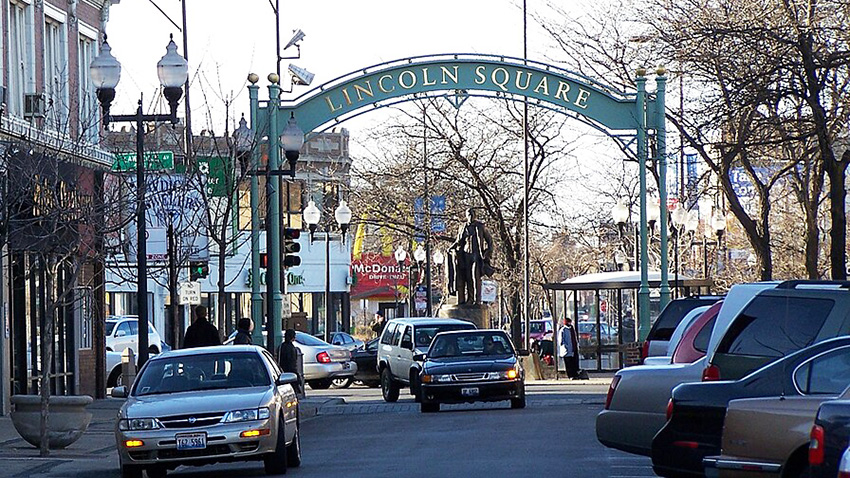
I walked north on Lincoln, phone still in my palm, like I was going to up and call Ma any second. There were carnival games that looked haunted and a funnel cake truck wrapped in Oreo branding. The more crowded the space around me grew, the warmer. The more narrow, the drunker. There were a few small tents with the kinds of wares I’ve never had interest in—like marionette stuffed animals and t-shirts with big Chi flag prints—and a larger tent for food and drink. Two beers per person was the limit. The workers wore feather hats and what looked like overalls. And when I looked over toward the central sound stage, I found something I hadn’t known I was missing.
The tapestry sign said “Maifest,” which rang a bell. A blonde woman in traditional frills swayed back and forth in front of a microphone, overlooking a troupe of teenage dancers. I’d heard of this before: the city’s annual celebration of German-American culture, run by some orgs mostly made up of the elderly. My teenage daughter, not German at all, twirled in the troupe of teens, also dressed in frills. If I hadn’t known her, I wouldn’t have been able to tell her blonde hair from the rest of them.
“Give it up for the young’uns!” the woman at the microphone called over the music’s final sting. She must have been my age, or a little older. “They always know how to bring the energy!”
This earned a cheer from the spectators and made me realize I was standing in the middle of foot traffic, about six feet away from the actual crowd. I clapped, to be polite. The loudspeaker blipped and then poured out another jig, similar to the one that had drawn me here. A fiddle led the melody forward, undercut by a mandolin and some kind of low drum. In front of me, another blonde-haired girl led my daughter forward by the hand. The two wore matching dresses, corset tops and red skirts with aprons. Their waistbands were embroidered, but they just looked speckled from where I was standing.
I stepped forward, out of the foot traffic. I couldn’t even look at the other faces around me, couldn’t bring myself to actively wonder if these were other parents of truly German American children, parents who knew how their daughters were spending their Friday afternoons. I couldn’t bring myself, either, to step into the circle—which the blonde dancer led my teenage daughter around by the hand—and demand answers. It wasn’t the kind of betrayal it was easy to feel angry about. I couldn’t get past my confusion and shock. I watched them dance, their eyes glassy and wide, until the music sputtered out again. Then, they pranced around like horses in lieu of taking bows. Then, near the back of the soundstage, near the street, I took my daughter by the elbow and brought her home.
***
We fought all through the night, until Saturday came. Still, at just past one, none of her explanations satisfied me.
“So you’ve been practicing when? After school?”
“No,” she said. “On Saturdays mostly.”
“After softball?”
“Yeah, I usually go straight from there.”
“Who drives you?”
“I take the bus.”
I had tried to rope my husband into the argument when he got home, but after my third time explaining that Molly, our non-German-American daughter, had been performing a German-American dance, he waved his hand, mumbled, and went upstairs to shower. So I was without backup.
“I just don’t think I get it, sweetheart,” I said to her. I tried to lay down my weapons, like you’re supposed to do with a teen, talk to her like a friend. “Gran and Pop are Danish. Your dad’s parents are from the Near East. It’s…where did you learn about all this?”
She drew her eyebrows together and scratched the bridge of her nose. We were standing on opposite sides of the kitchen island, having just finished a snack break from our fighting. The first hour was mostly me screaming, me raving about all the confusing little German flags in all of the windows, and me lamenting the troubles of raising a teenager. To be fair, Molly was an easier teenager than most. She liked school, other girls, and being outside, even when it snowed. Clearly, though, there were some key things about her that I’d been missing.
“I thought Gran was German?” she said then.
Her voice always sounded honest, which made it hard for me to keep stoking my anger. I felt a cloud of humor passing through me.
“Why would you think that?”
“Doesn’t she go to German church?”
“That’s because she’s Catholic,” I said. It had been a big point of contention when I was a kid: Ma had wanted to be Catholic to match the neighborhood demographic, and Pa had clung to the Lutheranism of his father. From the time I was born, in his own private stand against an already-complete assimilation, Pa went to a separate church on Sundays than we did. “She’s Danish, her parents came with their parents.”
Molly’s certainty seemed to be fading with the curls in her hair, which had deflated in the AC. “I could’ve sworn she told me she was German when we went for…she said her parents knew German when they came and tried to teach her. And she’s always making that cabbage stuff and the sauerkraut—”
“There’s a lot of cross-contamination,” I said, pressing my finger pads against the granite. I believe there was some kind of war, which the Danes lost, but parents like mine weren’t the type to sit us down and give us history lessons. “But I’m Danish. Ethnically Danish, one-hundred percent. You can ask your dad, but I’m pretty sure he’s—”
“Are you serious?” She pressed both hands to her face so hard I could see the whitening skin where the pressure was. “I told the people there I was a quarter German. I thought Grandpa would be mad. So I didn’t tell you guys, but now…oh my god.”
It sounded like some pretty hot water. And I tried to honor that, but I really just wanted to laugh. For hours, we’d sat on the couch, in her bedroom, at the island, poking each other where it hurt, circling words like responsibility and privacy and freedom, and now, it was almost two, and she’d cried and I’d cried, and now this. She’d been wrong. My mother had restaged her same old tricks, her bird in the hand, her ancestral train to nowhere. And if my dad could hear us now, his own granddaughter, unsure what nations her family was made of? He might just move back to Denmark, a place he’d never actually been, and bury himself alive there, out of spite. While I smiled and ran this through and shook my head, Molly had pressed her forehead to the stone.
“Are you serious?” she said again. “Like, are you actually serious?”
I decided it was a moment that mattered, a moment of my mothering that she’d probably remember for her whole life. And so I decided I’d metaphorically take her to the neighborhood church. I told her that she should stick with it, just for the weekend. She should tell them I was making her quit the group, but she would see this through and still dance the dance she’d committed to for Sunday.
***
She told me her performance was scheduled for one o’clock and that the Germans are notoriously punctual. I watched her prepare to leave the house at eleven, pretending for her father that we weren’t going to the same place. We’d decided not to tell him. He was a serious man, especially when it came to our daughter’s activities, and besides, we justified that we’d tried to tell him already. It was just too much to explain: the dancing, the history, the multi-generational misunderstandings with my mother. His own mother was the opposite. More recent immigrant that she was, she never left any breathing room for culture or memory to get lost.
Molly left with her hair half-up and with her backpack, which I’d seen her carefully fold her dress to fit inside. I wore leggings, like I was going to go on a regular walk, and even made a smoothie for my husband and me. I should’ve felt somehow illicit, having plans with our daughter that he didn’t know about. But the only bit that felt strange to me was the German thing. I’d never been to Denmark either, though I had a small flag in our bathroom and a windmill charm on my house keys. Germany wasn’t even that far, another blond-haired, blue-eyed, tradition-bound culture that panicked over anything less than purity. Yet, the just-quite-not-right quality of Molly’s mistake nagged at me. Were there ways parents these days were supposed to instill ancestral culture into their children that I’d missed? Could what I had as a kid even be called culture, those whispered arguments over faith between parents and the lack of photos, heirlooms, and tales, all lost in the travels? I knew my husband would understand if I told him all this, but I didn’t know how to. Simply put, I’d never had to think about it before.
It was more humid than it had been on Friday. I hated that, and I tried not to hate the accumulating crowds too, as I grew closer to the festival square. I heard those same jigs from two days ago. Molly told me that most troupes had two different sets, one for the beginning of the fest and one for the end, which was usually busier with visitors. Beneath the quick rhythm of the music, I tried to flow along with the crowd, past those same tents of wares and the food stand. I considered a beer, but you had to get your ID checked at a separate booth. Too much hassle.
Molly and I hadn’t discussed whether I should sit in the roped-off chairs, the section set aside for the parents of performers. I looked at it now. Most of the women were my age or younger, and some of them wore dresses in the same style as the performers: the frills, the pleats around the neckline, the colored skirts and Mary Janes. I noticed a few women who at least seemed not one-hundred percent German, though I knew I was profiling them, and there was no way I could start a conversation on that shared ground. I floated near the general crowd, and due to my height, I was able to find a place in the second-ish row of standers, my head positioned between those of two other women, who were also dressed to match.
I checked the time. A minute before one. When I looked back up at the stage, there they were, right on time.
Standing closer to my daughter this time, I could see the little pink flowers embroidered on her waistband, surrounded by swirls of green and light blue. She’d put makeup on, or else she’d just spent the last hour in the sun. Her pink cheeks mirrored the others. With her usual gentle defiance, she was the only girl to have chosen another girl for her dance partner, and the two of them stepped swiftly into the central circle, their legs perfectly mirrored in pale tights. She didn’t seem to see me in the crowd as the couples did an initial circle, settled in their places, and waited.
The announcer said something in English, something in German, and then the music kicked up with a muted bang. The teenaged dancers began to hop, carefully switching legs every other beat, their shoes soft against the stage. There was a certain uprightness of the chest, a turning upward and pressing out, a posture that didn’t seem to have a place in today’s world. The girls brandished their chests, led with their shoulders and knees. The boys wore vests and clean white button-downs, loose at the arms. Most of them had their vests covered in gold and silver pins, which glistened in the light. I tried to squint and catch the icons on these pins, but they moved too quickly, like wiggly disco balls.
“Aaaaaahoo!!”
It was my daughter’s voice, making a loud sound like a yodel. It took me a moment to find her in the dancing mass, and when I did, she had the biggest glowing smile on her face. Some of the people around me clapped in response to her sound, and I glanced at them, saw their eyes on the action. Another girl made the same sound, low in her throat, a cheer. It didn’t seem at all synchronized with her movements or with the music they all followed, and I wondered if it was one of those things guided by spirit or passion alone. The girls twirled, my daughter with them, and one of the boys yodeled in response, his hands momentarily cupped around his mouth. The sound magnified itself, and in all the spinning and jumping and lifting, I thought I saw their blurry faces all laughing together.
When the song ended, the kids came back down to earth. They looked out of breath and blissful, smiling through sweat. They took their lap around the circle of the stage, lined up two-by-two, waving at the audience with those same grins on their faces.
As they did, I turned my head, just to get a glimpse of the parents’ section. Almost every single one of them was on their feet. Some wiped moisture from their faces, a combination of sweat and tears. I saw two middle-aged women with garlands of fake flowers in their hair. An older dad in a really fraying beige polyester jacket, with long white hair, continued to bop back and forth as though the music had not yet stopped. In the front row sat two elderly men with Armed Forces hats, whose insignia I couldn’t see clearly through the heat. Their faces were perfectly straight, like forgotten kings presiding over familiar lands. I wondered if any of them had hit the two-beer limit, or if they’d sewn their granddaughters’ dresses, done up their curled hair. I forgot to clap, so caught up in everything. I forgot to call my mother, and she didn’t wait by the phone.
Lillian Lippold is a writer from Minnesota, based in Chicago. She edits The Bullpen, runs a lesbian-only writing workshop at the Lesbian Herstory Archives, and leads a Midwestern reading group at the pub. Her work has appeared or is forthcoming in the Cleveland Review of Books, The Masters Review, The Ana, Confluence, The Middle West Review and Sixty Inches From Center.